
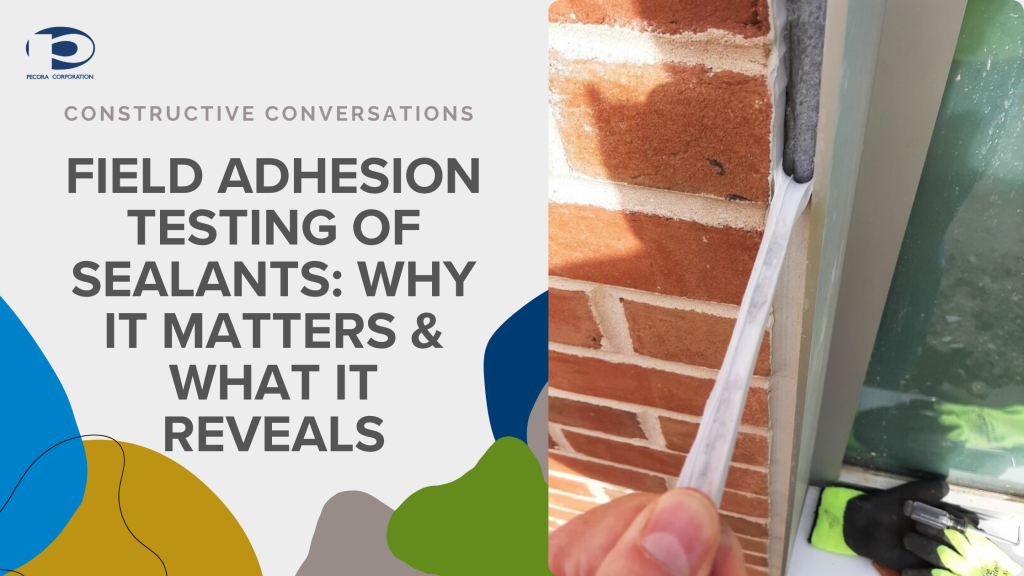
Laboratory testing is an important part of selecting the right sealant for a project, but field adhesion testing verifies that the sealant performs under actual jobsite conditions. Variables such as substrate condition, cleaning methods, environmental exposure, and installation practices can all affect adhesion in ways that laboratory testing alone cannot predict. For this reason, field adhesion testing is recommended before production work begins and after remedial sealant installations to confirm that the sealant has developed an adequate bond to the project substrates.
ASTM C1521 provides a standardized method for evaluating sealant adhesion in the field. After the sealant has cured, a section of the installed bead is carefully cut to create a pull tab while leaving both sides bonded to the substrate. The tab is then pulled by hand to evaluate the sealant’s adhesion and cohesive strength. A properly bonded sealant should remain adhered to the substrate while elongating or tearing cohesively. If the sealant releases cleanly from the substrate, the test indicates an adhesive failure that requires further investigation before the project proceeds. Field adhesion testing should always be performed in representative locations using the same substrates, surface preparation methods, primers, and installation procedures that will be used throughout the project.
A failed adhesion test does not necessarily indicate that the sealant itself is defective. In many cases, the results point to conditions that can be corrected before large-scale installation begins. Common causes include inadequate surface preparation, contamination from dirt, dust, oils, or curing compounds, omission of a required primer, incompatibility between the sealant and adjacent materials, or joint movement occurring before the sealant has fully cured. Identifying the cause of failure early allows installers to adjust their procedures before additional sealant is applied, reducing the likelihood of widespread repairs or premature joint failure.
Documenting field adhesion testing is just as important as performing the test itself. Test locations, dates, weather conditions, substrate types, joint/sealant dimensions, sealant batch numbers, primers used, cure times, photographs, and test results should all be recorded as part of the project documentation. Maintaining accurate records demonstrates that installation procedures were verified during construction and provides valuable support when reviewing project performance or submitting warranty documentation. Combined with proper surface preparation, installation practices, and laboratory verification of adhesion and compatibility, field adhesion testing provides an additional level of confidence that the installed sealant system will perform as intended. Please visit our website for more information and technical bulletins on adhesion testing https://www.pecora.com/resources/technical-bulletins-and-application-guides/.
